Market knowledge becomes an answer that machines can cite
Reliable figures for Saxony’s property market already existed in PDF market reports, official standard land values and the estate agent’s experience. Yet none of these sources answered the question owners actually ask: what is my property worth? A PDF cannot be queried like structured data, and professional judgement does not appear in a search index.
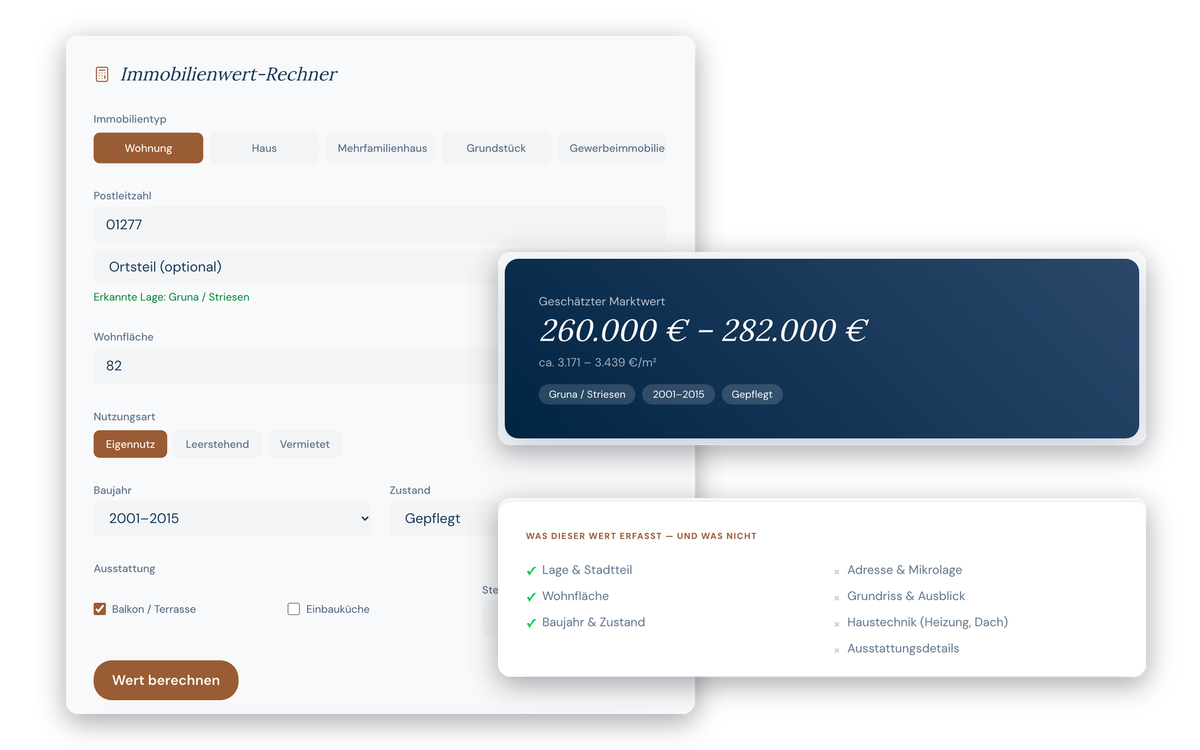
We moved the sources into a typed data layer: 49 price zones with per-square-metre ranges for apartments, houses and land, supplemented by income factors for apartment buildings and adjustments for condition, year of construction and features. Valuation logic uses location and property details to calculate a value range. The same foundation supplies direct answers, structured data and a machine-readable core-facts file. The number shown in the calculator is therefore also available where answer systems read.
The starting point: knowledge without a way to query it
The sources used different geographical frameworks. Market reports describe locations, official standard land values refer to zones with their own boundaries, and the estate agent thinks in streets. No mapping connected these frameworks in a form software could use. Search was also changing: more owners were asking answer systems, which depend on finding structured, citable information.
The turning point: one data layer serving people and answer systems
Combined sources
Market reports, official standard land values, official building coordinates and census structural data were mapped to a common framework. The result is 49 price zones spanning Dresden, Leipzig, Chemnitz and rural Saxony.
Added local resolution
When matching official building coordinates, we found 18 Saxon postcodes combining municipalities with markedly different price levels: 01796 covers Pirna, Struppen and Dohma. A postcode-only valuation would treat them alike. The tool now asks for the locality in these cases, distinguishing 3,873 localities.
Connected valuation logic
Location, property type, condition, year of construction and features produce a value range that reflects uncertainty. Rented properties and apartment buildings also use an income-based valuation bounded by upper and lower limits for each zone type.
Published for answer systems
Every page includes a direct answer in its source, structured data and an entry in a machine-readable core-facts file. Text is present in HTML without JavaScript so crawlers that do not execute pages can read it. The same data layer now supplies 16 calculators, 45 surrounding-area location pages and more than 1,100 content pages in German and English.
Immobilienpartner Sachsen supports owners selling apartments, houses, land and apartment buildings. Based on Königstraße in Dresden’s Neustadt district, it serves the city and surrounding municipalities.
Its location assessments use individual streets and property types rather than city-wide averages. This local calibration informs the data layer and distinguishes it from generally available price figures.