Two days at Brains on Silicon 2026


Brains on Silicon is a conference about applied AI in business. On 14 and 15 September 2026, people who develop, introduce or already use AI in their daily work met at the International Congress Center Dresden. Robert and I attended for esveo. Between talks and conversations, I kept coming back to how much our work has already changed and how much change might still lie ahead. Conference
A question for the audience
During a talk by OpenAI, the audience was asked who used ChatGPT. Almost every hand went up. For the next question, it looked to me like only about half as many did: who was already handing complete tasks to a language model?
At first, I was surprised. Delegating whole tasks to agents has become part of my daily work. The show of hands made me realise how quickly I had started treating that way of working as the norm for everyone else. People in the same room brought very different experiences with AI. For some, the step from a chat to an agent was still new, while others were already reshaping their workflows around it.
A pricing change reshapes my workday
For us, that step began with a pricing change. GitHub introduced usage-based billing for GitHub Copilot in the summer of 2026. That prompted us to switch to Claude Code. At the time, there was no plan to overhaul the way we worked. GitHub announcement
With the switch, individual snippets of code became less central to my attention. I started handing over larger tasks. Instead of just asking for a function, an instruction could now be: start the pipeline, watch it for errors and fix the cause. That meant delegating the steps between the first attempt and a working result, too.
Only gradually did I notice how much this was changing my workday. Switching tools had led me to describe tasks differently and try delegating longer sequences of related steps. That was why several topics at the conference already felt familiar.
Why a new motor alone changes little
Roman Howe from Anthropic offered a useful analogy. In his talk, he compared the introduction of AI to the electrification of factories. In this analogy, the larger productivity gains only emerge when the organisation of work changes along with the source of power. A new motor in an otherwise unchanged factory does not yet make full use of the technology.
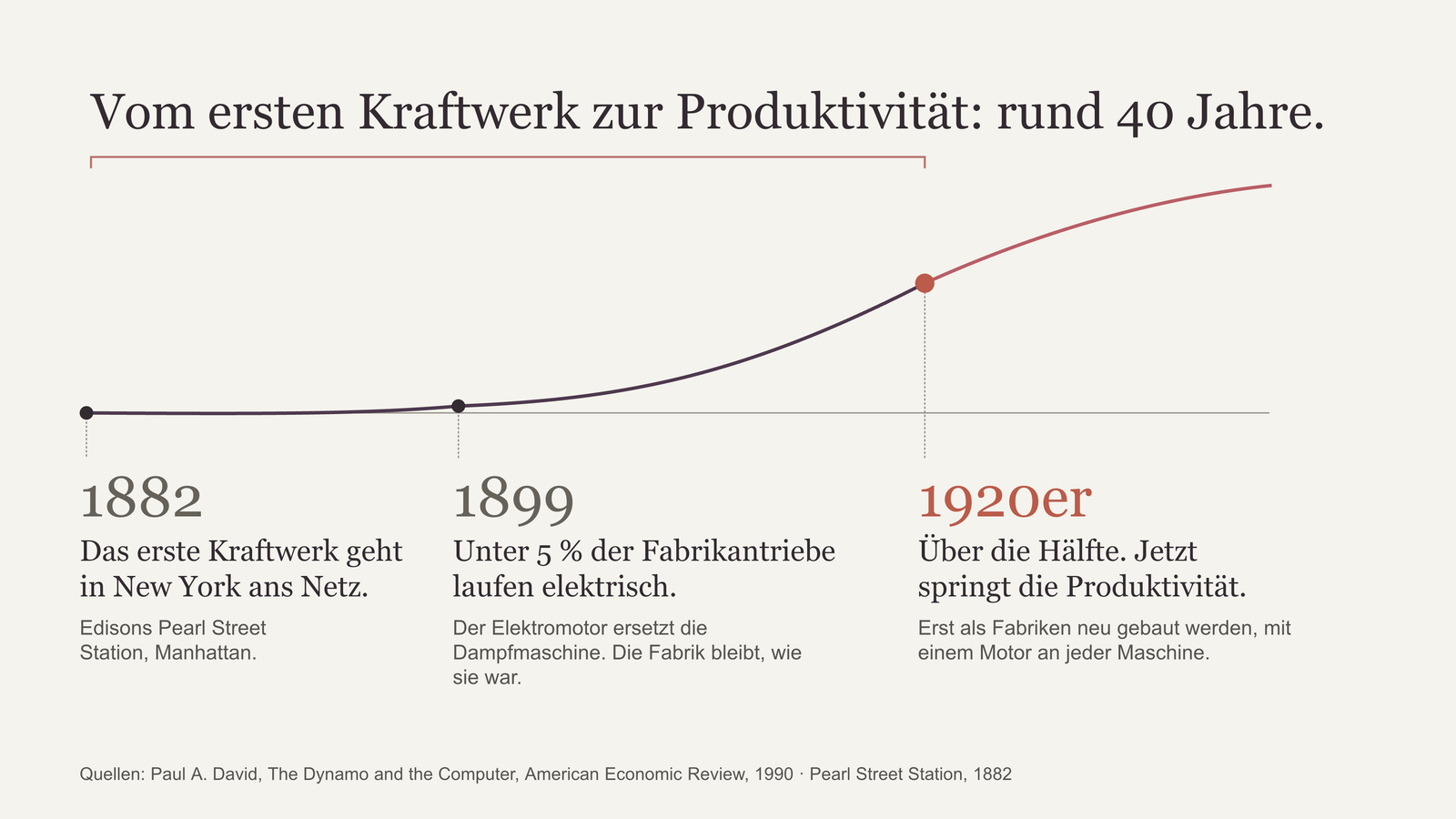
Source: Roman Howe, Head of DACH and CEE at Anthropic, presentation at Brains on Silicon 2026.
It reminded me of our switch. Initially, I had been looking for a different tool. By then, I was delegating tasks that I had previously broken down into individual steps and supervised myself. The comparison helped me make sense of that change. It also explained why companies need time to put new technical capabilities to use in everyday work.
We are still at the beginning of the curve
Robert was particularly interested in Howe’s outlook for the coming years. While companies adapt their workflows to today’s capabilities, the technology continues to develop. One of the slides argued that we have so far only experienced the flat part of the development curve.
A study published by METR in March 2025 provides a measurable reference point. It describes how the length of software and reasoning tasks that AI agents could complete with a 50 per cent success rate increased. Task length was measured by the time people with suitable expertise needed to complete those tasks. Over the period studied, this time horizon doubled roughly every seven months. That is an observation under test conditions; extending it into the future remains an extrapolation. METR study
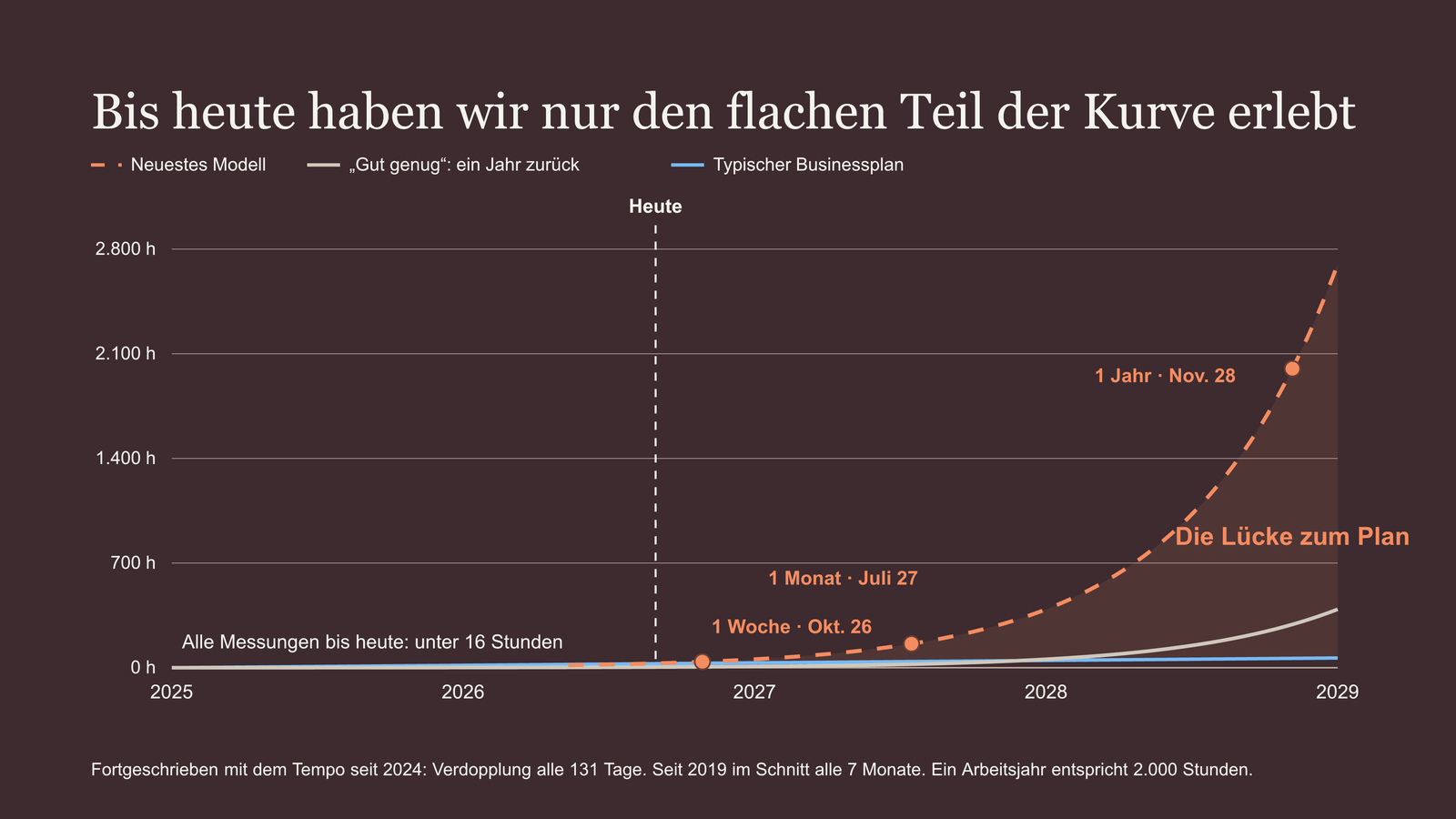
Source: Roman Howe, Head of DACH and CEE at Anthropic, presentation at Brains on Silicon 2026.
Howe’s outlook therefore goes beyond how companies introduce today’s tools. If the trend continues, agents could take on tasks whose scope far exceeds our current workflows. From that perspective, even those who already delegate whole tasks every day are still at the beginning.
I found that thought in Robert’s contribution particularly useful. My familiar way of working would itself be only an early intermediate stage. While I am still learning to work effectively with today’s agents, new capabilities could once again change which tasks I can delegate at all. Finding some of the conference content familiar therefore says little about how well prepared I am for the coming years.
Questions I would have liked to explore further
Some talks stayed too close to the basics for my needs. An agent benefiting from relevant company data is already something I have experienced in my daily work. Some sessions felt more like product presentations to Robert and me. At the same time, after the show of hands, I could better understand why introductory sessions had a place in the programme.
Several talks about Microsoft Copilot presented the choice between models as freedom. I would have liked to hear more about how easily the tools, permissions and configured workflows could also be transferred later. Skills and MCP came up, but mostly as an overview. I would have liked to spend more time hearing about people’s experience of using them every day.
Those conversations happened between the talks. With an engineer from an AI company, I discussed the pull of the next prompt and how tiring it can be to manage three or four agentic projects in parallel in a single day. I recognised that combination of productivity and exhaustion from my own work. We could get straight into comparing our experiences.
What I hope to see next time
Brains on Silicon was very well organised. I am glad this event exists in Dresden, and I would like to thank Stefan Queißer, CONFGAMES GmbH and the entire event team. A conference where people working in AI development and business practice can meet in person is a welcome addition to Dresden and Saxony. Organiser
For the next edition, I would welcome more room for concrete experiences with longer agentic workflows. How do teams change the way they divide up tasks, what works day to day, and where do people need to step in? I could well imagine contributing my own experiences. Especially if we are only at the beginning of this development, I want to hear what others have tried by this time next year.