Top rating for AI agents: AAA - Autonomous, Anywhere, Always On
Rating agencies award AAA to the most reliable borrowers. I award it to agents that are always running, work on their own and can be reached from anywhere. I show the three ways to run such an agent today, what has changed for me as a result, and which A decision-makers underestimate the most.

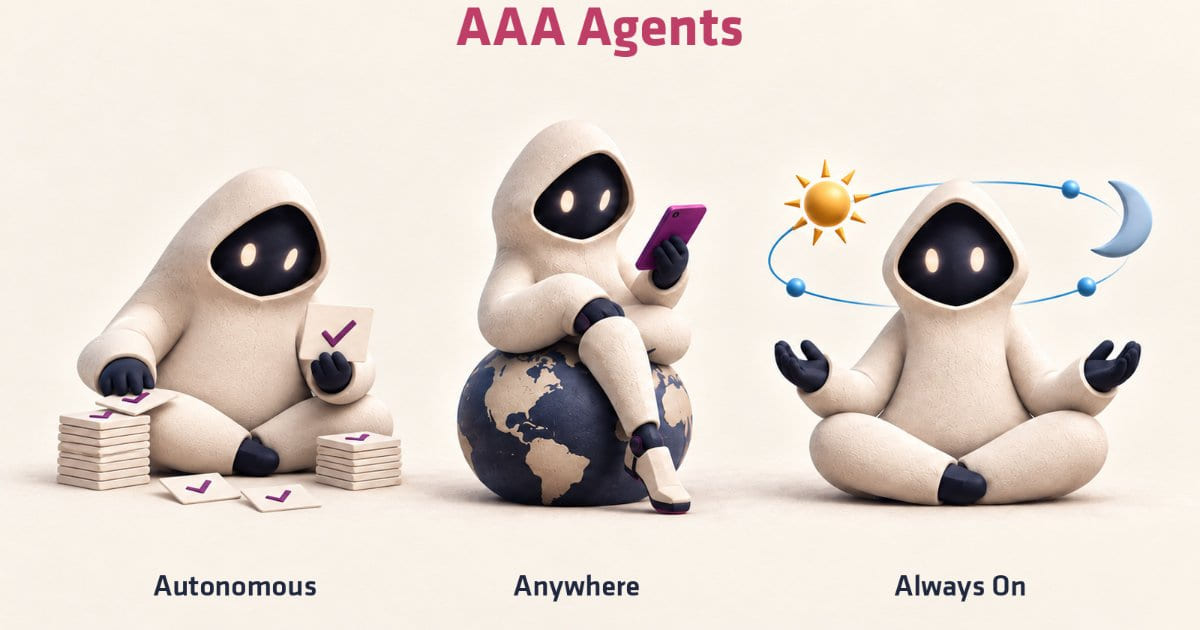
We know AAA, triple A, from credit ratings in finance. I am borrowing this top rating for AI agents. For them, AAA stands for Autonomous, Anywhere and Always On, and only the combination of all three makes an agent truly helpful.
I am a managing director, but these days I also develop software with AI myself. That is why I care not only about what an agent has to deliver, but also about where it runs. The two are more closely connected than they seem at first glance.
When an agent earns the top rating
In most companies I know, AI tools are chat windows today. You open one, ask a question, copy the answer and close the tab again. That saves time, while the company’s processes stay the same.
An agent with a top rating behaves more like a colleague. It keeps working when you close your laptop, and it starts on its own when an appointment is due or an email arrives. It gets a loose task instead of a specific instruction and decides for itself which steps are needed. And you can reach it wherever you are, without it forgetting what the two of you worked on last.
If one of the three A’s is missing, the rating drops quickly. If an autonomous agent only runs while my laptop is open, its value depends on my working hours. And if an agent runs around the clock but asks for confirmation at every step, it mostly produces notifications.
Three ways to run an agent
In practice, the first A quickly leads to the Mac Mini. Over the past months, many people have put one of these small computers on their desk so that their agent keeps working when the laptop is closed. Always On was the reason for the purchase. With tools like OpenClaw, Autonomous was added, because the agent no longer just waited for instructions but started tasks on its own. By now, cloud providers offer to run agents on their servers, and on X the Mac Mini is already being declared obsolete.
In my view it is not that simple, because there are three ways behind this, each billed differently. The first way is the one the AI providers themselves prefer. The agent runs in their cloud and is integrated directly into Claude or GPT applications. Or the agent runs in a managed environment at a hosting provider and is accessed through the API. Every request to the model costs tokens and money, and an agent working around the clock consumes far more than a person in a chat window. Continuous operation does not fit a flat rate, which is why providers steer it towards pay-per-use. In return, the environment takes care of operations for you and pauses as soon as the agent has nothing to do.
That is exactly why the Mac Mini runs the second way: a local instance on a subscription. For a flat fee you use the providers’ own applications, such as Claude Code or Codex, or integrate them into another coding application. On a computer in the office or on a rented server, no hour of runtime shows up on an invoice, and you take care of maintenance, access and security yourself.
The third way is new. The providers now run subscription agents in their own cloud, and these start on their own, on a schedule or when something happens in a connected system. This puts Always On within reach without your own hardware and without usage-based billing. These agents do not yet have full access to a computer, though. They work in an isolated environment with the integrations the provider offers. For many tasks, that is already enough. But an agent that is meant to move through all your systems like a colleague needs more access.
For me, the right way is rarely decided by price alone. Most of the time it comes down to where your data is allowed to go and whom you trust with the credentials to your systems. The three ways are not mutually exclusive either, and we will probably end up using several of them side by side.
What has changed for me
Since our agents have been running permanently, what has changed most is my response time and how quickly ideas can be validated. I can react and get things moving from my phone at any time, between two meetings, in the evening or on the road.
In the past, when I had an idea, I jotted it down, followed up on it the next day and saw how far I could get and how fast. Today I hand the task to an agent at the moment I would have written the note. I look at the results the next morning in the office, or already on the way there. The work starts immediately and not only once I am back at my desk, and that makes us faster as a team.
This requires all three A’s at once. The agent has to run at night, I have to be able to reach it from my phone, and it has to turn a note into a result without further questions. The third A is the one I discuss the most.
The underrated A
Most decision-makers and users I talk to underestimate Autonomous. They picture an agent as a faster assistant that you ask a question and that delivers an answer. That an agent works through a task on its own for hours, checks intermediate results and only comes back with a finished result is outside that picture.
Autonomy is less a question of technology than a leadership decision. You would not give a new employee all the keys on their first day, but you would not have them submit every email for approval either. You define what they may decide on their own, and you widen that scope as trust grows. With an agent you have to answer the same questions: what it may access, which steps it takes without asking, and who reviews its results.
No platform answers these questions for you. They belong with management, because they determine how much responsibility a company hands over to a machine. As long as nobody answers them, the agent asks at every step, and the lead gained from the other two A’s is lost again.
Our own setup is still growing, and I will report which of the three ways we end up combining. More important to me than where the agent runs is how much autonomy we grant it. If you are facing the same question right now, write to me.