A common data foundation for product range, pricing and stock decisions
At McFilter, variants, sets and bills of materials are spread across inventory management, marketplace accounts, logistics invoices and two tenants. Each source calculates differently, so standard reports only ever answered part of a question.
Unimatrix continuously imports these data, maps them to shared domains for products, orders, invoices, listings and sales channels, and supplies precalculated metrics to dashboards, detailed analyses and other applications. Demand forecasting, stock projection and Order Brain use the same foundation, connecting raw source files to operational decisions.
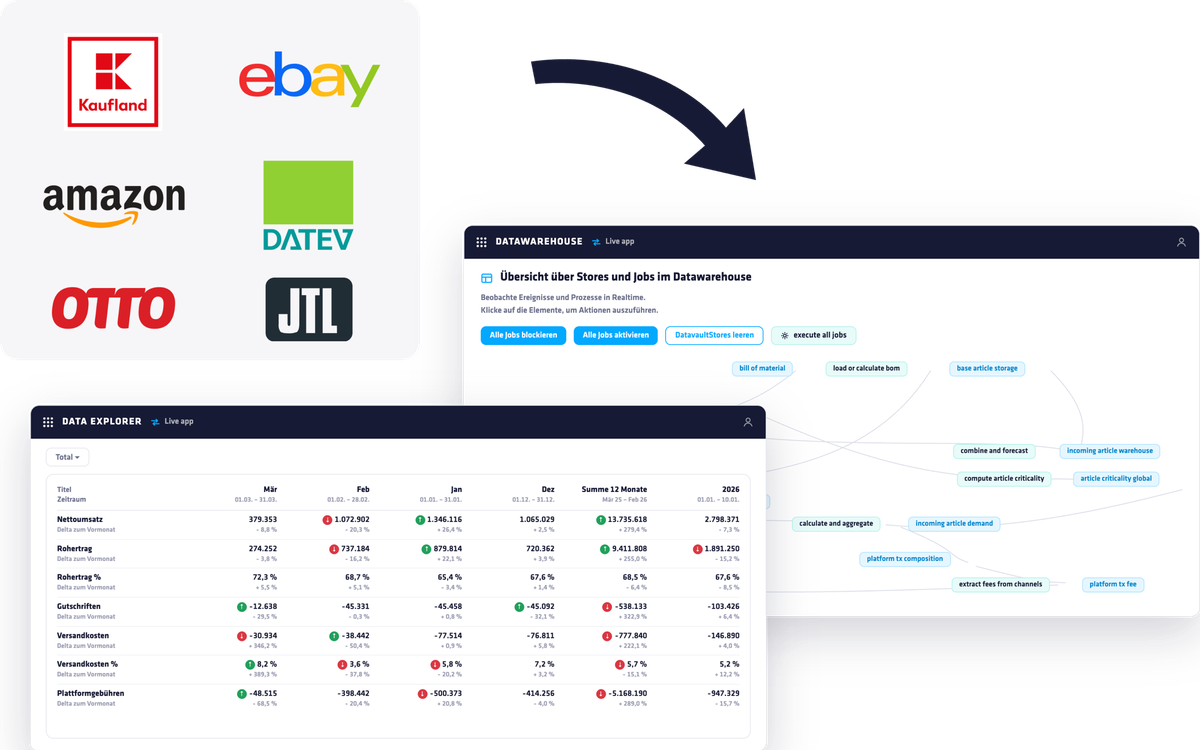
The starting point: five source systems without a common data foundation
The question sounded simple: are we making money on this product? Answering it meant combining marketplace statements, an inventory management export and a logistics invoice by hand. By the time the figure was ready, it was out of date. Two people rarely reached the same answer to the same question.
The turning point: one data model across all channels and tenants
Connected sources
Relevant JTL-Wawi data are continuously replicated alongside Amazon statements, FBA and catalogue information, eBay financial transactions, Kaufland booking reports and DHL invoice and shipping data.
Standardised settlements
Every marketplace breaks a transaction down differently: fees, revenue and shipping portions appear in different places under different names. We mapped these components to a common schema and broke sets and recursive bills of materials down to component level. That made profitability comparable across channels.
Precalculated metrics
Revenue, net proceeds, fees, shipping costs and gross profit are calculated centrally and provided by date, channel, customer group and shipping country. Purchase prices and stock retain their history so past periods can also be evaluated correctly.
Checked quality
Business rules continuously check orders, invoices, bills of materials, stock and configuration, sending notifications when discrepancies arise. The processing pipeline is visible and controllable, with jobs, errors and run times retained in its history.
McFilter is a medium-sized e-commerce company that has its own products manufactured internationally and sells them across Europe through marketplaces and its own shops.
Alongside product development, the company manages shipping, warehousing and logistics planning itself. Manufacturing and sales are distributed across two tenants.