Skip to content
References·Commerce & service·eCommerce

Transfers to Amazon warehouses: planned from stock and demand

Since February 2026, 95,567 units have moved from the main warehouse to Amazon across 1,200 reviewed line items. Every item uses the same calculation: what Amazon holds, what it sells and what is already in transit. Purchasing adjusts and approves the proposals, and the inventory management system receives complete transfer orders.

Key facts
610 active FBA products are planned on fixed dates: ready-to-ship items on Fridays, items requiring assembly on Mondays
Goods in transit count towards stock: every projection includes the 14 days between shipment and availability at Amazon
Approved transfers become JTL-Wawi orders with an order number and downloadable export file
Kenekos items also generate a McFilter order because McFilter physically handles shipping
Client
McFilter
Industry
eCommerce

Planning stock from the main warehouse to Amazon

Amazon can only sell what is in its FBA warehouse. A full main warehouse does not help the marketplace, and the standard time between dispatching a transfer and Amazon marking it available is 14 days. Sales continue during that period. A late transfer loses revenue that timely replenishment could have secured.

Transfer planning projects stock day by day for every FBA product, subtracting expected demand and adding transfers that have arrived or are still in transit. If stock cover falls below the target, it proposes a transfer for the next scheduled date.

Supplier purchasing is handled by a separate planning process. This process concerns goods the company already owns.
FBA transfer planningStock projectionStock cover planningBill-of-materials breakdownJTL-Wawi integration
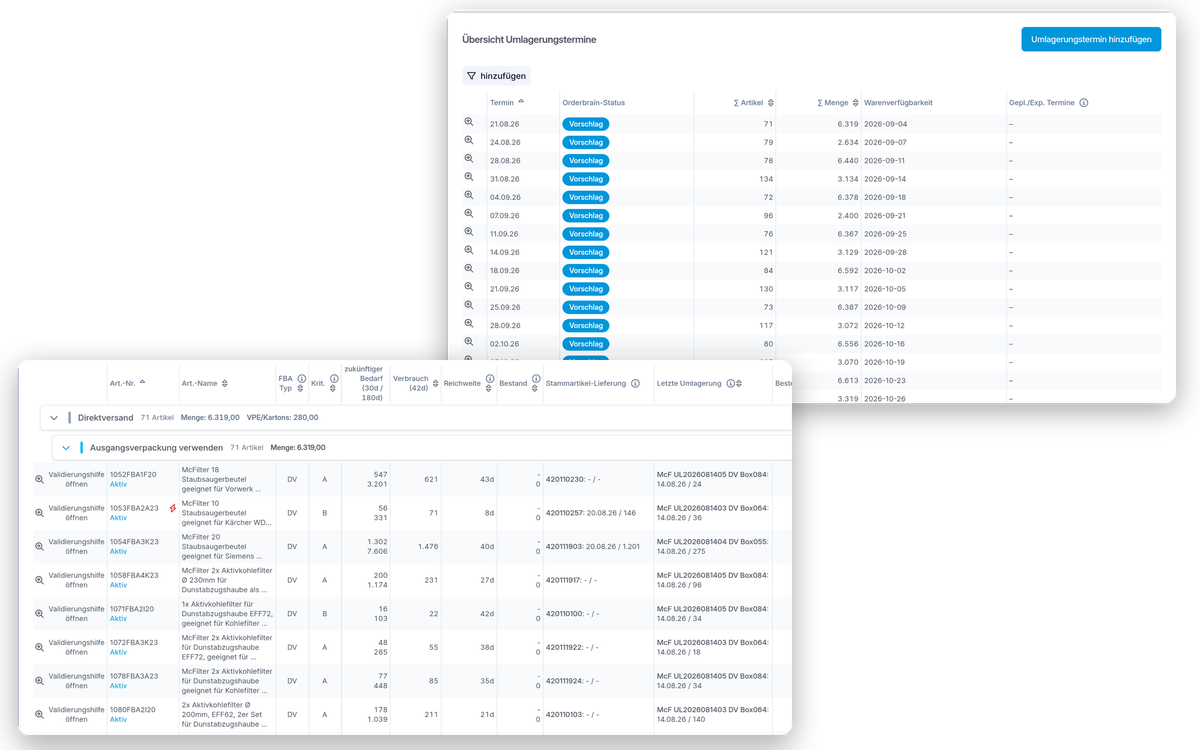
Transfer planning: schedule overview with quantities and goods availability, with detailed requirements, stock cover, stock levels and base-product deliveries per item in front

The starting point: stock in three places without a shared view

A product’s stock is spread across the main warehouse, Amazon warehouses and transit. Deciding how much to send and when requires a joint view of all three, plus expected demand by marketplace and whether the main warehouse can supply the quantity. Without that view, planning requires several datasets and extensive coordination.

Amazon’s actual storage date can only be estimated externally: it redistributes goods between its warehouses and reports receipt in parts
FBA products are often sets, with several drawing on and competing for the same base-product stock in the main warehouse
Some products need assembly before shipping while others ship directly, requiring different lead times
Kenekos sells through its own FBA accounts, but McFilter ships the goods: two tenants share one physical flow

The turning point: schedule, quantity and approval

01

Projected stock

Three figures underpin each product: FBA stock from daily inventory history, requirements from the sales forecast, and the target and buffer stock cover configured by McFilter. Every suggestion shows the shortage it addresses.

02

Established schedules

Transfers follow fixed days: ready-to-ship items on Fridays and items requiring assembly on Mondays. The calendar contains 233 such dates plus manually added catch-up dates. The scheduled date and transit time determine when Amazon will hold the goods, shown in every overview.

03

Checked supply

A suggestion depends on available goods. Planning breaks the bill of materials down to the base product, shows its stock and next expected delivery, and flags when several FBA products draw on the same stock. Products blocked from FBA shipping are highlighted.

04

Exported approvals

Users review line items, change quantities and approve them. When Kenekos products were added, we found that Amazon credits the goods to Kenekos while McFilter physically ships them. The export now creates a second order for McFilter alongside the Kenekos order, using the bill of materials to convert items into McFilter base products.

Each date has a status: suggested, planned, overdue or exported. The overview also shows product count, quantity, goods value and the date of availability at Amazon.

95,567
units transferred since February 2026
Reduced Amazon storage costs
Supply information in the same row
Base-product stock, the next expected delivery and the last transfer appear alongside requirements and stock cover in one system.
Marketplace feedback
Each exported order shows what Amazon did with the shipment, such as completing or cancelling it.
Traceable exports
155 of 158 orders were exported, each with an order number and downloadable file.
Planning by exception
Users approve unchanged suggestions directly and spend time on manual adjustments only where the figures require them.
McFilter

McFilter has sold vacuum cleaner bags and accessories through the major online marketplaces since 2004. Based in Ebersbach-Neugersdorf in Saxony, the company handles product development, purchasing, warehousing and shipping in-house.

Two tenants cover 39 active sales channels on Amazon, eBay, other marketplaces and the company’s own shops. Amazon FBA brings its own logistics requirement: goods must already be there for a sale to happen.


Visit McFilter’s website

Customer story: McFilter

Loading yard at an Amazon logistics centre in warm morning light: a long dark facade with the Amazon name above loading bays, a white truck at the dock and light reflected across the forecourt

We develop planning tools that derive the quantity, location and date of a stock movement from the same data. Every suggestion remains open to review until approval.

Robert Kramer
Founder and CEO

More references

All references